

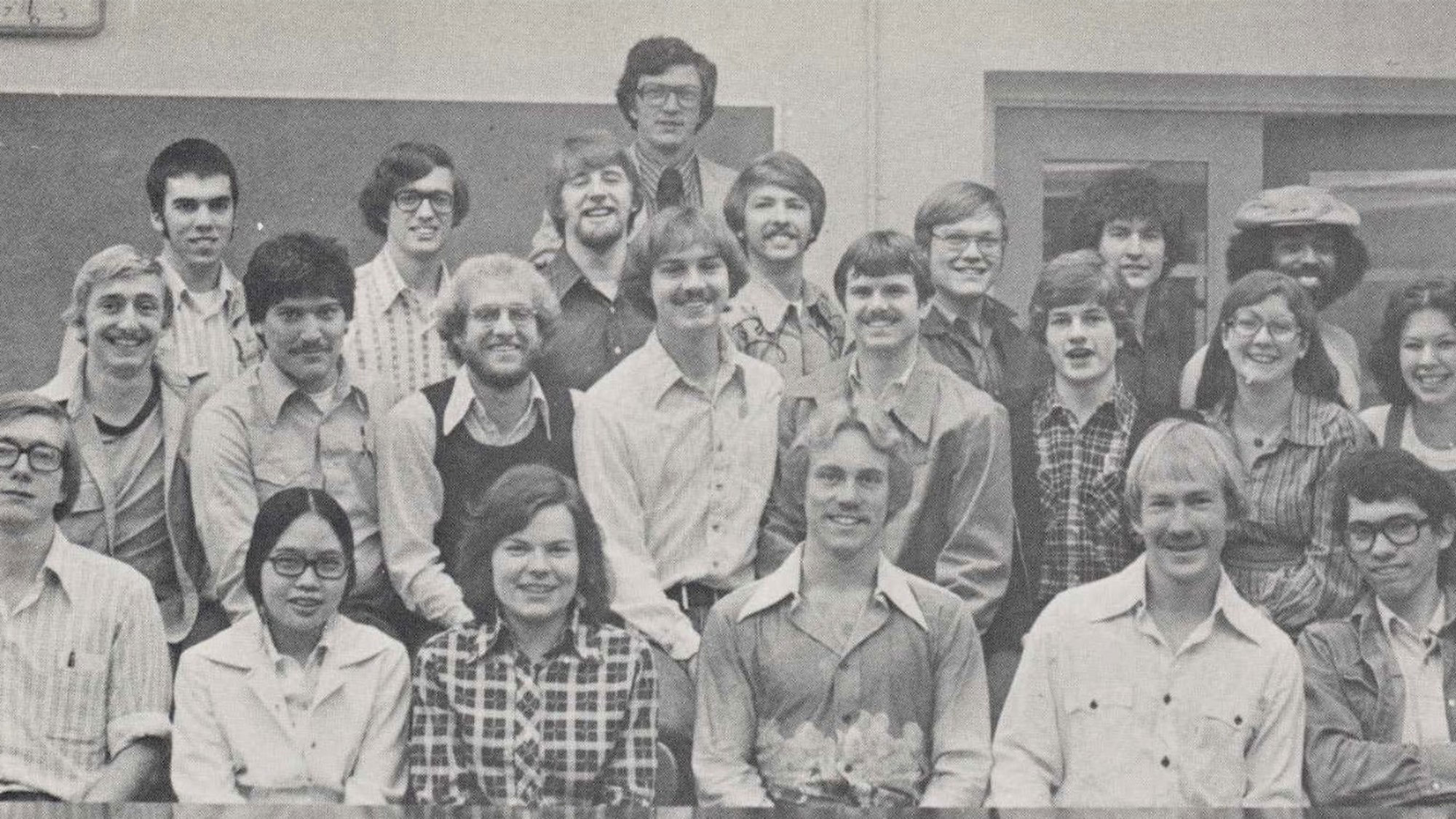
“I knew from the time I was in first grade that I wanted to be a scientist,” says John Hill ’79, astronomer emeritus at Steward Observatory in Arizona.
John has certainly achieved that goal, acquiring advanced degrees in astronomy and working for many years to create, maintain, and improve the capacity of the Large Binocular Telescope at the University of Arizona’s observatory.
His journey to a calling in the sciences was quickly focused as a vocation looking at the sky.
John experienced the benefits of good teaching early. In first grade, his teacher shared both knowledge and excitement for science, which John caught. As he continued to explore the sciences, this first-grade teacher continued to lend her support. John later spent time in high school building a telescope in the backyard with two friends. Around the same time, John visited a college fair where he first learned about Geneva College.
One of the two individuals representing Geneva at the fair was John Schaefer, associate professor of physics, who also had a degree from MIT and received his master's from the Carnegie Institute of Technology. Through this conversation with Schaefer, John saw how, at Geneva, serious science is intertwined with serious Christian faith. Quickly, his college decision was a “done deal” and the combination of passion and mentorships that would shape the rest of his career began.
Once at Geneva, John became close friends with Kerry McMahon ’79 and John Stahl ’79 (now both professors emeritus in Geneva’s chemistry department), with whom he still stays in touch. He remembers being challenged by the rigorous classes (like Organic Chemistry with Roy Adams, PhD; chemistry faculty, department chair, and professor emeritus) as he pursued degrees in chemistry and physics.
Later, John had the opportunity to be the Teaching Assistant for the Astronomy class and shared the joys of the night sky with other students as often as the clouds of Beaver County permitted. (Today, Geneva’s observatory is named for John Paul Schaefer, the father of the John Schaefer who was the original point of contact for John Hill.)
This experience, combined with John’s high school telescope experience, helped him to focus his scientific passion on the sky. As we read in Psalm 139 about the Lord, “Where can I go from Your Spirit? Or where can I flee from Your presence? If I ascend into heaven, You are there...” and Psalm 19 reminds us that the heavens declare God’s glory and His handiwork.
Regarding his Geneva education, John reflects, “I would certainly make the same choice again.” While a major research university may have its benefits, John notes that “you miss out on all the personal interactions with your professors” at a larger school.
After his undergraduate preparation and studies at Geneva, John moved to the University of Arizona’s Steward Observatory for his doctoral studies, where he began working on a series of projects and processes with his doctoral advisor. These projects especially focused on borosilicate honeycomb mirrors, which have a lightweight but rigid design that continued to be useful while the processes and application were refined throughout the four decades of John’s career, which closed with his retirement in April 2025.
John's career included major contributions to the development, operation, and advancement of the Large Binocular Telescope (LBT) and its associated optical systems. The LBT consists of two 8.4-meter mirrors on a common mount and is one of the world's most powerful optical/infrared telescopes. The telescope is operated through an international partnership involving institutions in the United States, Italy, and Germany. Now, recent research has observed details such as being able to study a volcano on Jupiter’s moon Io at comparable quality to in-space telescopes but over a much greater time period. John takes it as one of the greatest joys of his career to see the LBT “doing science.” He also had the opportunity to pass along his knowledge through assisting PhD candidates and other researchers during his tenure.
One of the chief groups who utilizes the Large Binocular Telescope Observatory (LBTO) is the Istituto Nazionale di Astrofisica, Italy’s chief astronomy body. Through this collaboration, John had many opportunities to travel to Italy. In his travels, the Humanities classes, which were less obviously useful to him in his college days, were a blessing. John visited the Uffizi Galleries and saw many art pieces that he studied in prior years, gaining a better appreciation for both the artwork and how he was taught.
At his recent retirement celebration, many colleagues noted John's kindness as one of his defining attributes. This, he reflects, "had something to do with Geneva."
As scientists who excel in their field, like John Hill, continue their work to explore the vast detailed and beautiful realm beyond the earth, they help to teach us of our vast, detail-oriented, and creative Lord.
Throughout his decades in the field, John met many other scientists of faith who shared his passion for the heavens and their Maker. Geneva strives to prepare more scientists with the same rigorous, faith-filled education that John received.
The Geneva Story publishes content from a variety of contributors across the Geneva College community. The perspectives, experiences, and conclusions expressed in this content are those of the individual authors and do not necessarily reflect the official views of Geneva College, its leadership, or its editorial staff.
Amelia Jones
- Amelia Jones is the advancement marketing project manager at Geneva College in partnership with the Geneva College Foundation.
- View author





Recent Articles
Homecoming 2026: The Old and the New
Geneva College's 2026 Alumni Awardees
A Geneva Landmark: 95 Years of McCartney Library
Geneva College's 2026 Young Alumni Awardees
Wargo Hired to Take over Cross Country and Track and Field
Remembering 9/11: Geneva College Responds to a Day That Changed America
Geneva Professor Publishes Biblical Answer to Age-Old Question in TableTalk Magazine
A Closer Look: How Do I Decide What to Study?
The Mountains Surround Musical Group to Perform on Campus
Three New Schools Partner with Geneva College for Beaver County Direct Admission