

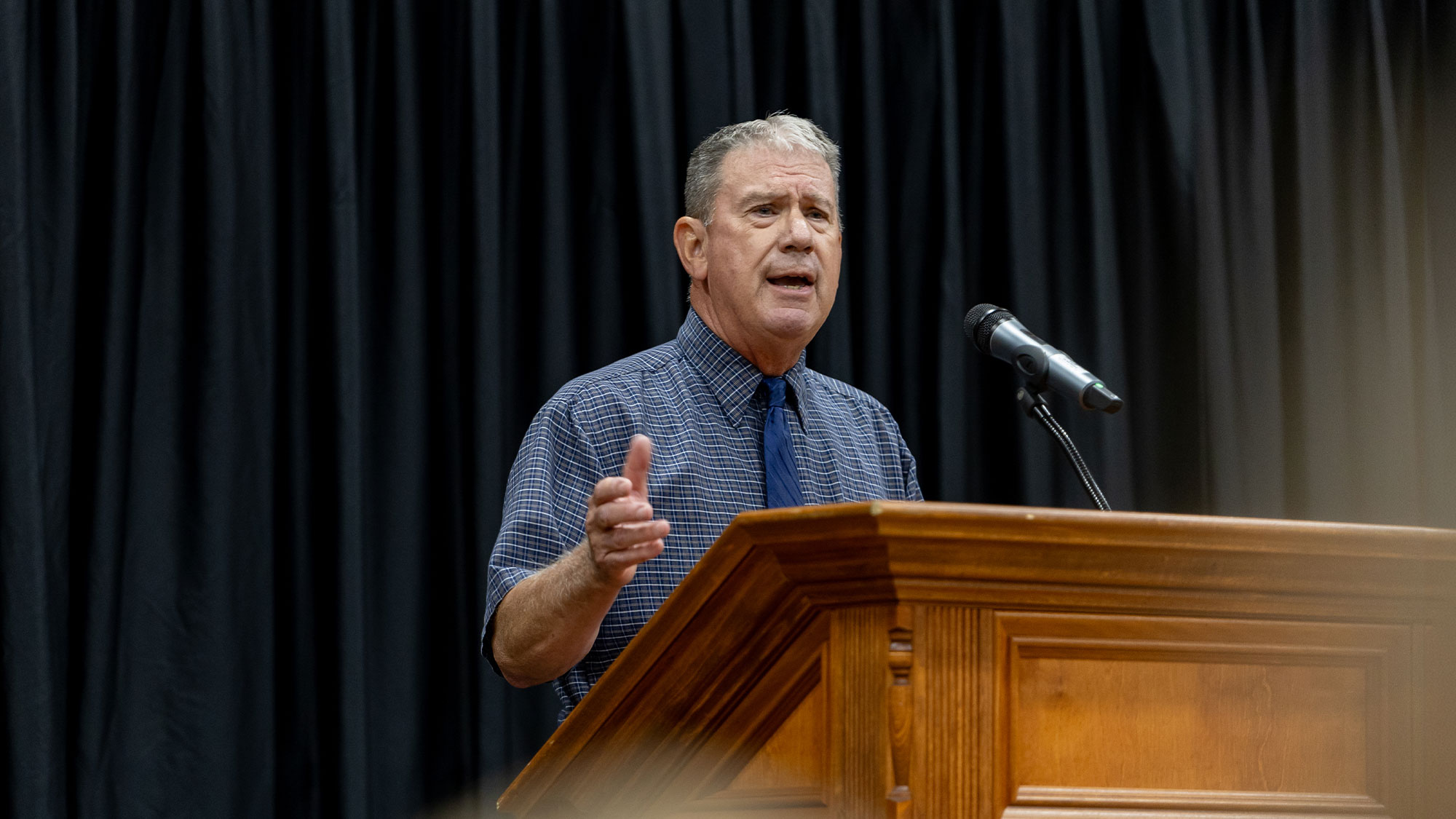
For those of you who learned under Prof. [Ed] Dambach or worked alongside him or even had friends who were in his classes and sang his praises, you understand why many of his students attended his viewing and funeral. For you sophomores and freshmen who came after Prof. Dambach stopped regularly teaching, I want you to know just a few reasons why we loved him so much and try to give you some of the admiration that comes for so many with the mention of his name.
Prof. Dambach knew us and loved us. He knew that we were and are, sinful students who needed discipline and he gave it to us with love. The very first day of Calculus I, he warned us that if we wanted to become engineers or accountants and enjoy high-paying jobs, then we needed to learn how to work hard. He would tell us if we were “behind the eight-ball” in our studying or if we did poorly on our exams. None of us wanted to disappoint him. But his discipline was not the kind that discouraged. Prof. Dambach’s discipline was born out of love and a desire to see us grow and so was woven with hope and encouragement. He told stories of students scoring terribly on the first two exams and then working hard and raising their next exam score by 30 points. He celebrated the student with the most improved score after every exam by calling out his name so that we could congratulate him. And he even knew the name of that student without needing to look at a chart, because he knew us all by name within a couple of weeks of the start of the semester and for a long time afterwards. My sister Liz Samuelsen had him for two weeks as a substitute, and he always remembered her name. He trained us in other ways as well. He wanted precision from us and would press us until we relented. In everything he wanted us to learn well.
Prof. Dambach communicated to us that what we were learning was good and beautiful. For the first few minutes of class, Prof. Dambach would often teach from a projector—the kind that uses clear plastic sheets—with slides he made himself. Often, he would present some kind of mathematical problem. Leading us through how that problem was solved like he was telling a good story and the climax of the story would be what we were learning for the day which was always some method or equation. That way we better appreciated what mathematicians before us had discovered. He showed enthusiasm for what he was teaching and always celebrated what we knew. One day in class, my roommate Daniel Rader remembered the unit circle for a problem and Prof. Dambach said, “Mr. Rader. You are a jewel. A jewel.”
And he would sing for us! He took familiar tunes and put lyrics to them to help us remember something for class. And it worked. I still remember the definition of the definite integral and the method of “u” substitution to the sound of Prof. Dambach’s voice.
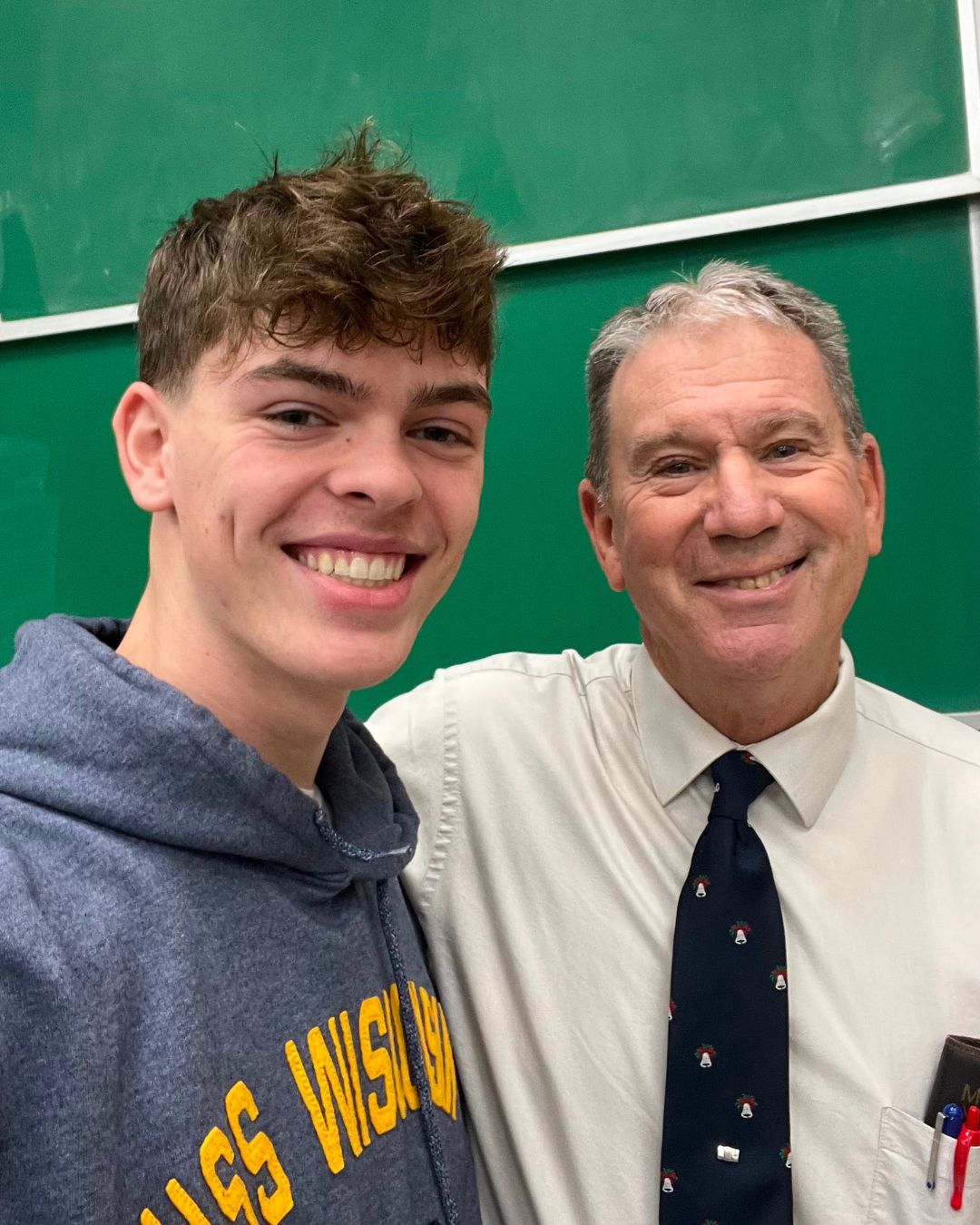
He would joke with us and tease us during class. When one of us said that we would solve a problem using “brute force,” he asked, “what do you mean by brute force?” picked up a textbook, and started shaking it and growling at it. Is that what we meant by “brute force?” He did not let us get off without participating. He would call on us to answer problems and questions, and it made us think and learn better, and enjoy it more. A few among us learned how to tie a tie during Calculus II and still have one of Prof. Dambach’s ties to prove it.
Prof. Dambach shared lessons for life with us. Every Monday morning, he began class by writing a passage from the Bible on the board. The lesson was often coupled with a story from his own life. He did not treat them as simply slogans, but real wisdom for living that he wanted us to know. One day was a singular day for Prof. Dambach. It was the anniversary of the day that Diana Dambach, his wife, died thirteen years before. He told us his grief and how he lived through his grief and took comfort in God and continued on to teach us.
So, we weep for the death of Prof. Dambach and remember the love he showed us. I only know the story of how Prof. Dambach loved me and my classmates and friends, yet there are thousands of students who could tell such stories. If this is your first introduction to anything about Prof. Dambach, I know that there is something that he would want you to know: his hope, who he lived for. Prof. Dambach was a Christian. He trusted that Jesus is the creator of everything, and took Jesus at his word when he said, “whoever believes in me, though he die, yet shall he live.” He knew that this day would come, and had confidence that when it did, he would be with Jesus forever.
This article was originally published by The Geneva Cabinet in Vol. 150, Issue 8, on March 30, 2026, and republished with permission by the author.
The Geneva Story publishes content from a variety of contributors across the Geneva College community. The perspectives, experiences, and conclusions expressed in this content are those of the individual authors and do not necessarily reflect the official views of Geneva College, its leadership, or its editorial staff.

Peter Samuelsen
- Peter Samuelsen '27 is an engineering student at Geneva College.
- View author





Recent Articles
Homecoming 2026: The Old and the New
Geneva College's 2026 Alumni Awardees
A Geneva Landmark: 95 Years of McCartney Library
Geneva College's 2026 Young Alumni Awardees
Wargo Hired to Take over Cross Country and Track and Field
Remembering 9/11: Geneva College Responds to a Day That Changed America
Geneva Professor Publishes Biblical Answer to Age-Old Question in TableTalk Magazine
A Closer Look: How Do I Decide What to Study?
The Mountains Surround Musical Group to Perform on Campus
Three New Schools Partner with Geneva College for Beaver County Direct Admission