


On May 9, 2026, author Nancy Pearcey addressed Geneva College graduates at Commencement. Pearcey is the author of Love Thy Body: Answering Hard Questions About Life and Sexuality, as well as The Toxic War on Masculinity, The Soul of Science, Saving Leonardo, Finding Truth, and two ECPA Gold Medallion Award Winners: How Now Shall We Live (coauthored with Harold Fickett and Chuck Colson) and Total Truth. She is a professor and scholar in residence at Houston Christian University.
Read Pearcey’s transcribed commencement address below.
Thank you so much, President Troup... And thank you to everyone else who makes this unique university possible. Trustees, staff, faculty, parents, and, of course, especially today, students.
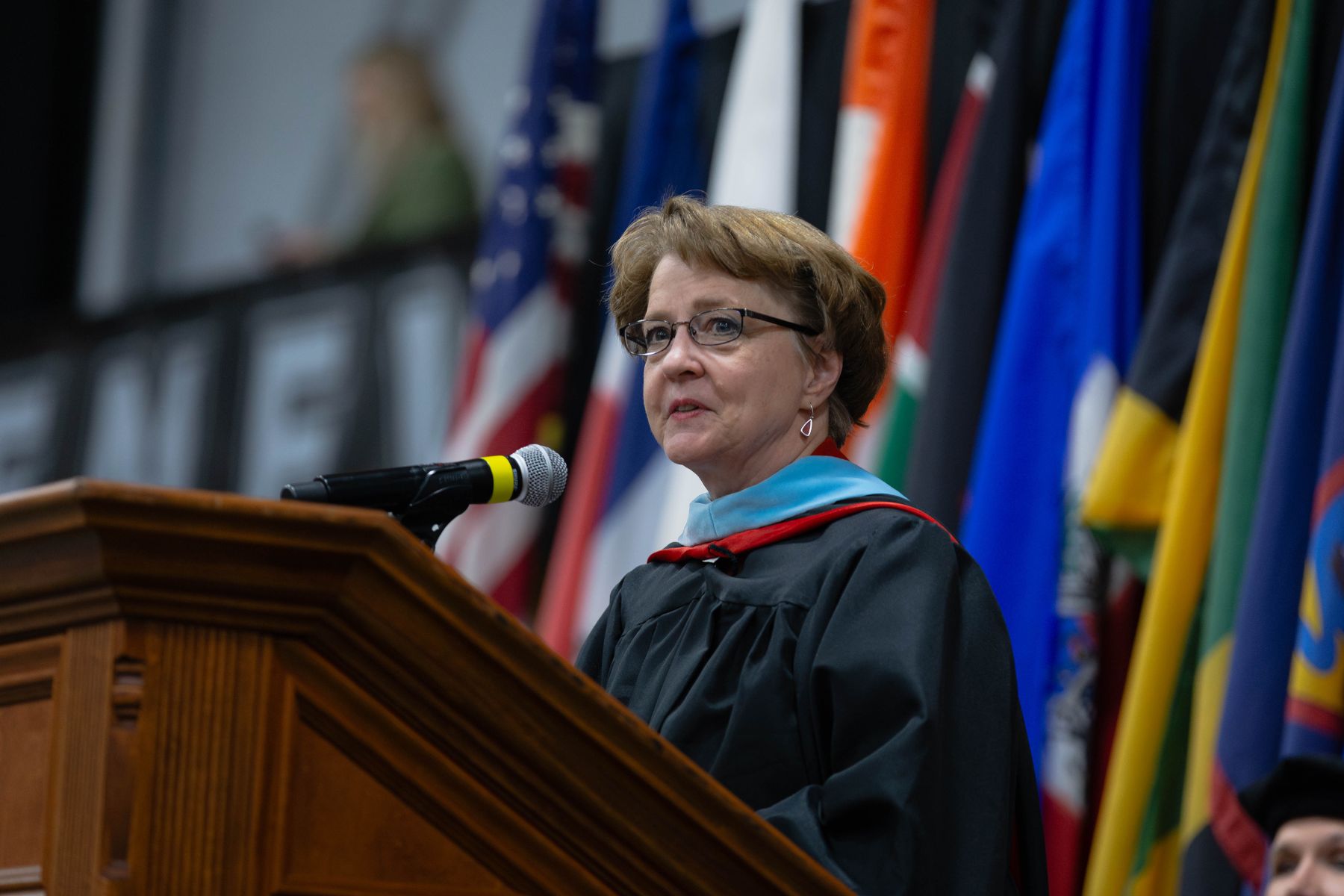
I come to you today as an emissary from the world of evangelicalism. I'm a professor at Houston Christian University, which until recently was Houston Baptist University, and my message to you who are graduating, as you prepare to leave Geneva... my message is that the wider Christian world needs what you have learned these past four years...
My own story is I was raised Lutheran, where you go to church to learn that Jesus died for your sins and you can go to heaven... and that's about it. For every other part of life, it was considered fine to apply concepts borrowed from the secular world. The first time I ever encountered the idea of a holistic Christian worldview was when I studied at L'Abri in Switzerland, which is the ministry of Francis Schaeffer. Francis Schaeffer's roots are in the reformed theological tradition. And his message was, "Christianity is not just a series of truths with a small ‘t’. It is truth with a capital ‘T’. Truth about all of reality, from law and politics to business and economics to arts and culture.” This was a much richer vision of Christianity than anything I had ever heard before. It was inspiring and it was empowering.
But over the years... I've met people who grew up within the reformed tradition — perhaps most of you here — people who were taught to list creation, fall, redemption from the time they were four years old... and sometimes they lose that sense of excitement, that enthusiasm that people have when they're learning it for the first time. Let me illustrate what I mean.
I used to teach for a summer journalism program that was started by WORLD magazine, and students came from all over the country, both evangelical and reformed universities. And what struck me is that the students from reformed schools pretty much took worldview thinking for granted. By contrast, the students from evangelical schools were amazed and excited to learn that Christianity is a comprehensive worldview that speaks to all of life. I remember one student in particular, a young woman from an Assemblies of God college, and she kept saying, "Where'd you get this stuff?" It was completely new to her and she loved it. At my own university, Houston Christian, at the end of one of my classes, a student told me, "I always thought Christianity was just about raising your hands and saying, ‘Praise Jesus.’” He had no idea that Christianity applies outside of church and worship.

But what really helped me realize how unique the reformed tradition is were two articles that appeared not long ago. One was by an atheist sociologist, and it was titled “The Opening of the Evangelical Mind.” The other was by a liberal Catholic that was subtitled “The Evangelical Mind Awakens.” Both of them were reporting on a trend of evangelical thinkers who were actually engaging with the secular ideas and starting to do first rate scholarship. But where was that trend coming from? Both articles, both the atheist sociologist and the liberal Catholic, said that the scholarship in the evangelical world is coming from the reformed theological tradition from Neo-Calvinism. So... the evangelical world is taking its intellectual leadership from the reformed world.
My goal today is to impress on you how unique your education here has been at Geneva. It's a gift that God has given you, not just for you personally. It's something for you to take out into the wider Christian world. Most people are hungry for a richer understanding of Christianity, but they're trapped in the sacred-secular split. Let me give you a few examples.
A few years ago, I read an article by a young woman who had just graduated from a Christian high school... and she said, "On the first day of theology class, my teacher drew a heart on one side of the blackboard and a brain on the other side. He told us that the two are as divided as the two sides of the blackboard. The heart is what we use for religion, the brain is what we use for science.” How can students learn to love God with all their minds when they're taught that their minds don't even apply to religion? They end up with a Christian heart but a secular mind.
Some Christian academics even think faith and learning should be kept separate. Listen to this. A Christian philosopher says, "I have myself definite religious convictions, but I would consider it entirely wrong to make them intrude as tacit presuppositions in my academic work." Academics like this have bought into the idea that secular knowledge is neutral and objective, while Christian knowledge claims are biased and subjective. A study was done of Christian universities, and it found that those that operate with this kind of sacred-secular split are “sitting ducks” to become completely secular. That was the language that the researchers themselves used: These universities are sitting ducks. Why? The study says they have Jesus in their hearts but secular ideas in their minds.
So what happens when students are taught from a sacred-secular split?
Here's a few examples. An English professor at an evangelical college wrote a newspaper article in the local newspaper saying he was stunned when he read his students journals. On one page, they would describe intense worship experiences and on the next page they would describe their sexual encounters. The professor wrote, "My students are rampantly promiscuous. There's a significant gap between what they're professed to believe and how they live.” So what does that tell us? That students who have a Christian heart but a secular mind end up living just like secularists.
I wrote a book about the sacred-secular divide. It's called Total Truth. And a 17-year-old blogger wrote a review — that's how you know you're reaching your target audience, [a] 17-year-old blogger... But here's what he said: Many of my peers act like “double agents.” His word. They are Christians in church but have a completely secular mind.
So how can we help people overcome the sacred-secular divide? Here's a strategy I have found helpful and you might also.
There are two versions of Christian thinking. What we might call the Genesis 1 version and the Genesis 3 version. Let's start with Genesis 3.
What do we read about in Genesis 3? The Fall, right? It's about how the human race fell into sin. And if you start your message there, it leads to the classic revivalist message: You're a sinner, you need to get saved. And that's true. But starting with the Fall tends to reinforce the sacred-secular split. Why? Because it implies that this world in its essential nature is fallen, sinful, broken, wicked, and corrupt. That there's nothing of value in this world. There's very little sense that biblical truth applies to our work in this world in education, politics, science, business, and so on. And since work takes up most of our waking hours, that means a huge part of life is sealed off from what matters to us most. Some of you may know Dorothy Sayers, she was a friend of C.S. Lewis, and she wrote, “How could anyone remain interested in a religion which seems to have no concern with nine-tenths of his life? No wonder people say Christianity is irrelevant.”

So what about the Genesis 1 version? What do we read about in Genesis 1? Creation. And we also read what we might call the first job description. God has created the first human couple, and what is the first thing He says to them? He explains why He created them, the purpose of the human race: Be fruitful and multiply and subdue the earth. In the streamlined language of Genesis, we can unpack several layers of meaning. Be fruitful doesn't just mean the nuclear family. Anthropologists tell us all of the social institutions historically grow out of the family — it becomes a tribe, a clan, a nation. You also need social groups for specific tasks. You need a church, a school, a government, a marketplace. So the phrase actually means to develop the entire social world.
The second phrase, subdue the earth, means harness the natural resources. Again, anthropologists tell us most societies start with agriculture but then move on to mining and technology. They build cities. They design computers. They compose music. I had a student once who said, "Oh, come on, compose music?" So I said, I play the violin. What's the violin made out of? Wood. And do you know the bow? It's horsehair. So all the transcendent beauty that we associate with music starts with harnessing the raw materials built into God's creation.
What do reformed thinkers call this? ...Cultural mandate. It means that God has called us to create cultures, build civilizations, make history. When I talk to my students, less than half of them have even heard the term cultural mandate...
I was speaking at an evangelical college once and a faculty member said, “Oh, these are western problems, these are first world problems.” And I said, “No, these issues have impact all around the globe.” The reason is that Christianity is growing all around the globe. For example, at the beginning of the 20th century, do you know how much of Africa was Christian? 9%. Today, in sub-Saharan Africa, do you know what the number is? 62%. And yet many of these societies still suffer from poverty, hunger, war, violence. Why isn't Christianity making more of a difference?
The problem is that Western missionaries imported the Genesis 3 version of Christianity with its sacred-secular split all around the globe.
Here's how one Canadian philosopher puts it: “In places like Africa, western missionaries generally brought the Gospel in the way they learned it, as a purely soul-saving faith with no real bearing on anything else. Religion was mostly a personal matter.” A theologian from Ghana in West Africa puts it this way: “Churches have taught that Christ came only to save souls, not lives. Thus, large churches have been built. Thousands of people go to church each Sunday. But what has not happened is transformation of entire communities.” And finally, a South African theologian says, “If we want a new Africa, we need a new type of Christianity.”
I'll end with a positive example of that new type of Christianity. In Guatemala, the Poqomchi' Indians are subsistence farmers. They're among the poorest of the poor. And the traditional religion there is animism or spiritism. [Animism is] spirits in the rocks, spirits in the trees, spirits in the river. And you might do little rituals to placate the spirits, but you really have very little control over your life. It's a religion that creates a passive, fatalistic, fear-based mindset. People have the sense that if you're poor, you will always be poor. There's no use trying to better your life. A generation ago, missionaries came to the Poqomchi'. They planted churches and many of the Poqomchi' accepted Christ, but they stayed poor. They knew they were saved. They knew they were going to heaven. But they did not think being a Christian involved any special calling for this life. They were basically waiting to die and go to heaven. We might say they were converted in their religion, but not in their worldview; they were still passive and fatalistic.
Later, secular development organizations came in with lots of money. They built things like schools and sanitation systems. But when these secular groups left, the Poqomchi' did not use any of these expensive projects. If your worldview tells you when you're poor, you'll always be poor, why send your children to school to have a better life?
Finally in the 1990s a young Peruvian pastor came to the Poqomchi' and his name was Arturo Kubo. He worked for an organization called Disciple the Nations Alliance and he taught the Genesis 1 version of Christianity, that we’re meant to exercise stewardship and dominion over nature.

For example, one reason that Poqomchi' had so little to eat was that they did not have good storage for their crops that kept being eaten by the rats. So the young pastor asked the farmers, "Who is smarter, you or the rats?" And the farmers laughed a bit sheepishly and said, "Well, I guess the rats are... they are winning." “So who has dominion here? You or the rats?” And the farmers had to admit in a real sense the rats did. So the pastor taught the cultural mandate, that they're created in God's image to be creative, to take initiative, to have stewardship and dominion in this world, not just the next world. So the farmers did develop a better method of grain storage, the food supply began to increase, the children had better nutrition, their standard of living began to rise. And it all began with a shift from a Genesis 3 mindset where Christianity is just how to get saved and go to heaven to a Genesis 1 mindset that says Christianity gives principles for your family, your work, the marketplace, every area of life.
That is God's job description given in Genesis 1. And not only for them but for all of us.
So my commission to you as graduating students is to recognize the uniqueness of the reformed worldview that you've been taught here at Geneva. No other theological tradition has the richness of reformed thought about what it means to have a biblical worldview and to fulfill the cultural mandate. So I urge you to treat your education here at Geneva as a gift that God has entrusted you that's not just for you, but to benefit the wider Christian world because it is what the world needs now.
Thank you very much.
Listen to Nancy Pearcey’s full commencement address on the Geneva College YouTube channel (31:15).
The Geneva Story publishes content from a variety of contributors across the Geneva College community. The perspectives, experiences, and conclusions expressed in this content are those of the individual authors and do not necessarily reflect the official views of Geneva College, its leadership, or its editorial staff.

Geneva College
- The Geneva College Department of Marketing and Communication strives to provide a regular flow of information with the Geneva community.
- View author







Recent Articles
Homecoming 2026: The Old and the New
Geneva College's 2026 Alumni Awardees
A Geneva Landmark: 95 Years of McCartney Library
Geneva College's 2026 Young Alumni Awardees
Wargo Hired to Take over Cross Country and Track and Field
Remembering 9/11: Geneva College Responds to a Day That Changed America
Geneva Professor Publishes Biblical Answer to Age-Old Question in TableTalk Magazine
A Closer Look: How Do I Decide What to Study?
The Mountains Surround Musical Group to Perform on Campus
Three New Schools Partner with Geneva College for Beaver County Direct Admission