

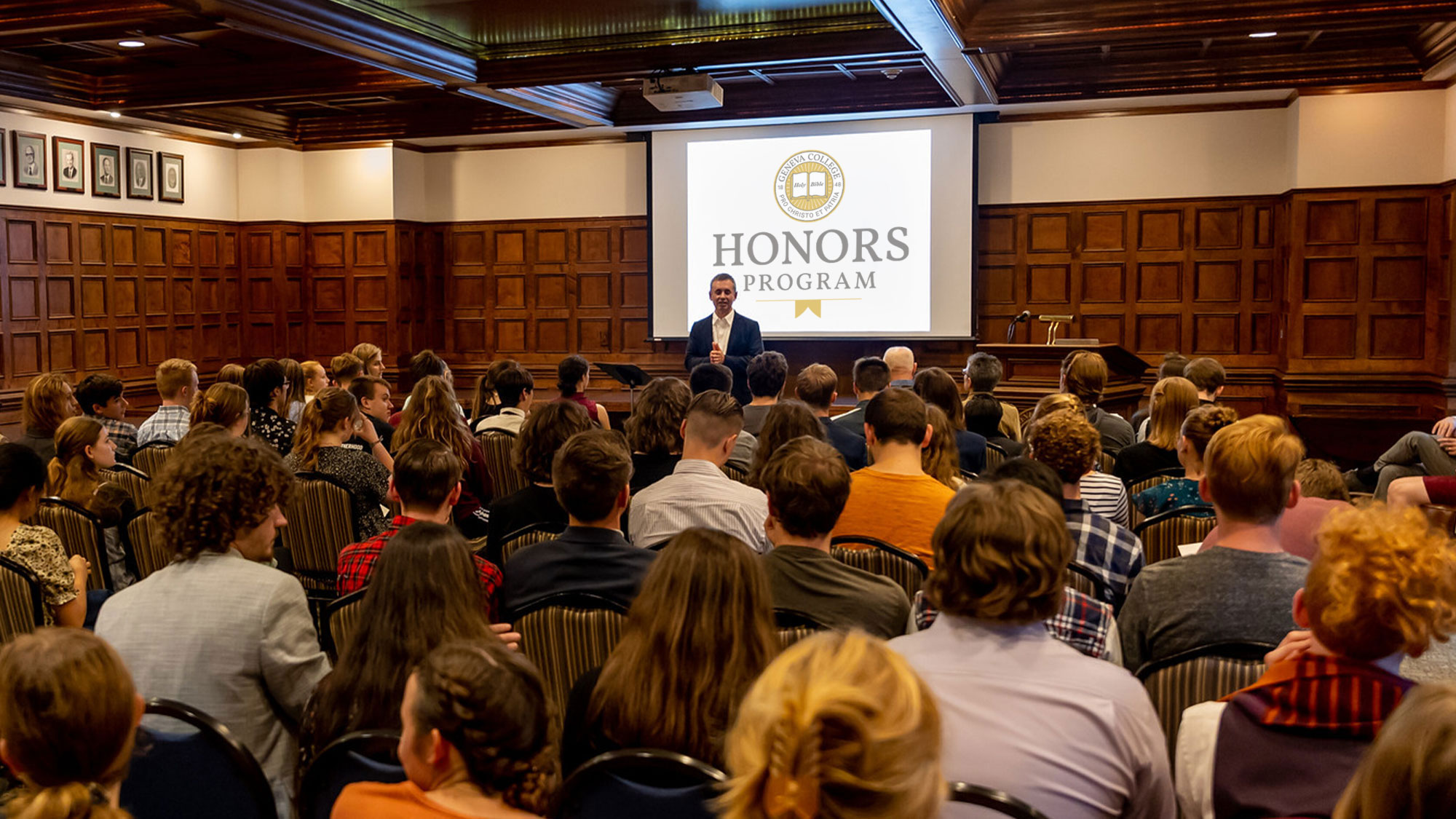
On February 5-6, 2027, many of Geneva’s brightest incoming freshmen will arrive on campus, pencils in hand, for the two-day Honors Invitational. On Friday night, attendees will enjoy dinner together and hear from a featured speaker. The following afternoon will include faculty lectures, Works of Our Hands presentations from Honors students, a word from the college president, and more. But on Saturday morning, after breakfast in Alexander Dining Hall, students will be tested to prove they are fit for the Honors Program.
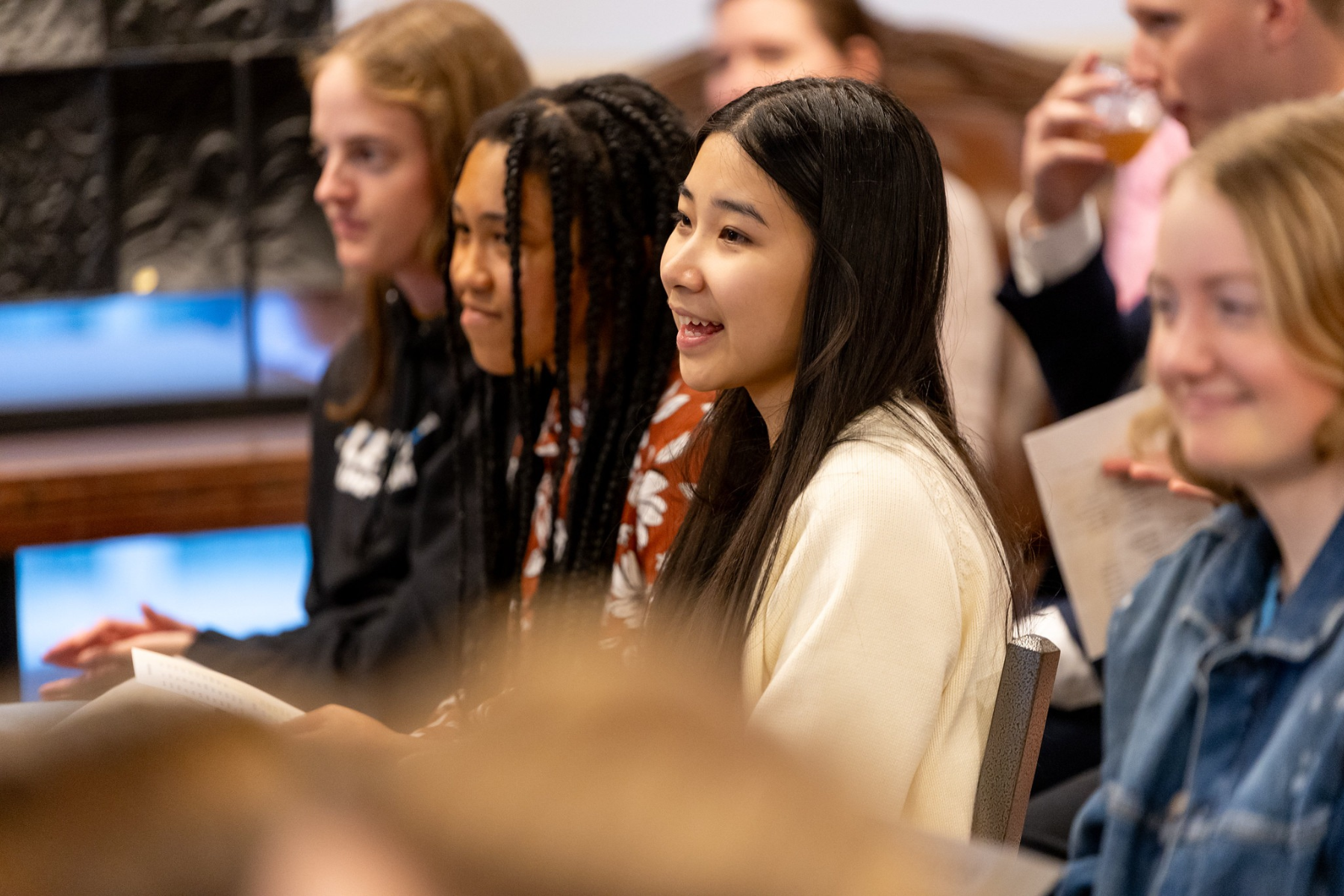
According to Bridget Fox, director of Crossroads: Center for Enriched Learning, Geneva’s Honors Program invites high school seniors with a GPA of 3.6 or higher to compete for membership. The competition consists of a 20-minute interview with a faculty or staff member and a current Honors student, as well as a 40-minute timed essay. The essay is a response to an article selected by the Honors Program, which students receive in advance and are encouraged to read, annotate, and bring to the competition.
After the event is held, faculty members review the interviews and essays to evaluate each student’s fit for the program. Rather than reapplying each school year, Honors students who are chosen as freshman are accepted for all four years of their undergraduate education.
The purpose of the Honors Program is to encourage students who have proven themselves to be diligent and passionate learners to achieve their full potential during their time at Geneva College. Together, they learn to engage culture faithfully and pursue academic excellence. The program welcomes students into a community of peers and faculty members who share their love for learning, making the College feel more like home.
Students in the First-Year Fellowship live together on designated dormitory floors. At the beginning of the fall semester, they take a one-night retreat to launch both into the material of their first honors course, HON 101, and into communion with each other. HON 101 is a replacement for the standard Learning and Transition course, and freshmen in the program will also be placed in Honors sections of HUM 103: Invitation to the Humanities. During the spring semester, the students take Civil Society Near and Far, a society course taught by Julie Durbin, PhD, who also teaches writing and humanities.
Students are encouraged during their first year to consider membership and inquiry as a framework for learning, preparing them for successful college years. The end of the spring semester includes another retreat, where students reflect on memories made and lessons learned, considering how to apply them in the second year of the program.
Sophomore year, Honors students participate in a one-credit course, The Thinking Christian, that continues the program’s emphasis on the integration of faith and learning. Sections of the course are taught by Daniel Cross, PhD, associate professor of physics, and Eric Miller, PhD, professor of history and the humanities.
During the spring, students are invited to take Academic Faithfulness, taught by President Calvin Troup, PhD, which fulfills a core Bible requirement. Those who cannot add the course to their sophomore year schedule are able to take it during their junior year instead. This flexibility shows that the program was not designed to burden students — instead, Honors courses help students view learning as a privilege and reach their full potential.
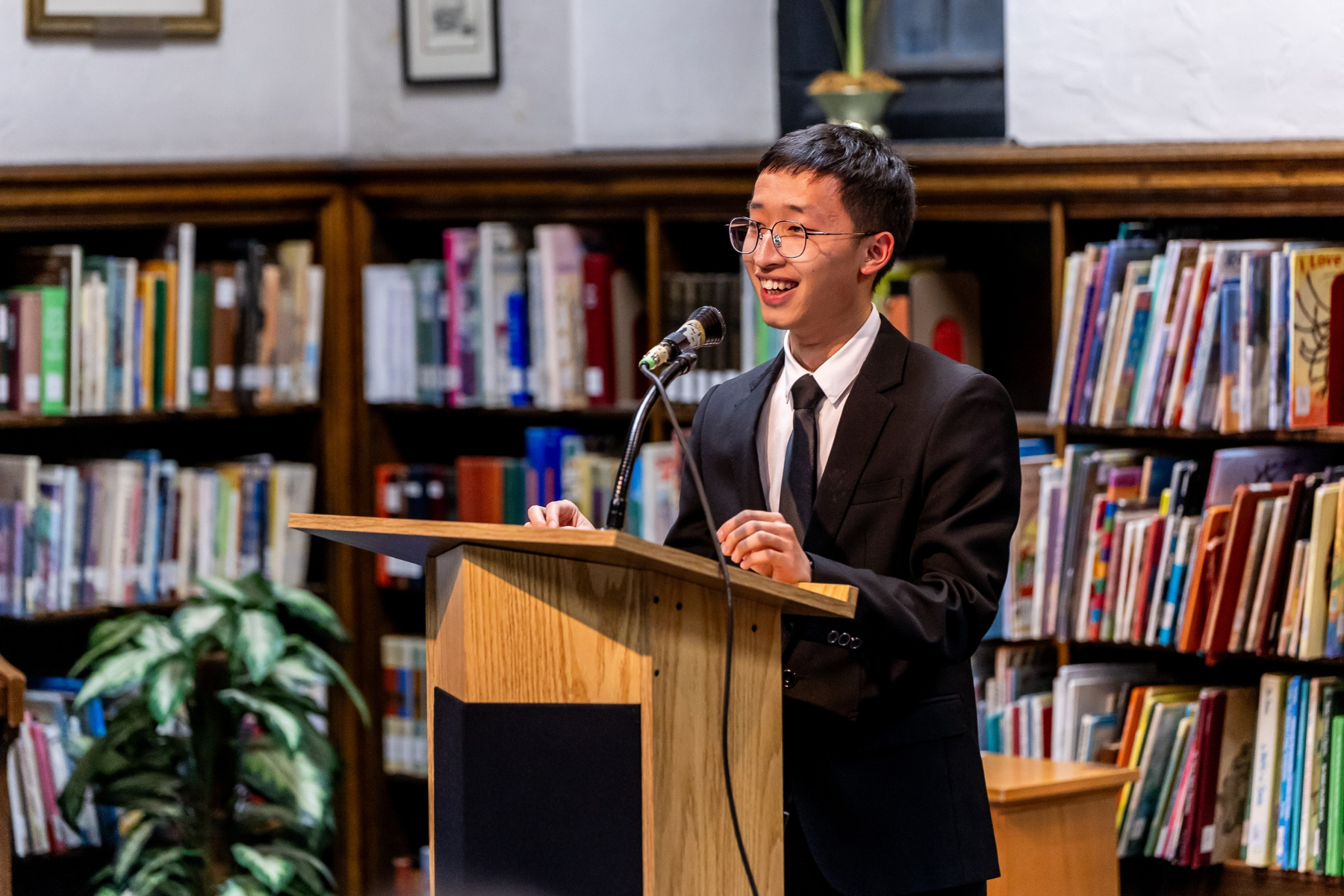
In 2025, the Honors Program added a course for year three: Civic Presence. This one-credit course encourages students to consider their civic responsibilities as Christians seeking to live actively in their communities. During the spring of year three, Honors students may also begin their Academic Partners projects.
Academic Partners is the capstone of the program and consists of two parts: a faculty-supervised research project and a one-credit seminar. During the seminar, according to Miller, the Honors Program director, students “study and critique the intellectual culture of the contemporary academy.”
Miller says the capstone research project, which corresponds to each student’s field of study, creates a bridge to their careers after graduation. Students partner with faculty to conduct research and share their completed projects in Works of Our Hands presentations at the end of the semester. Academic Partners receive a stipend to help cover the costs of their research.
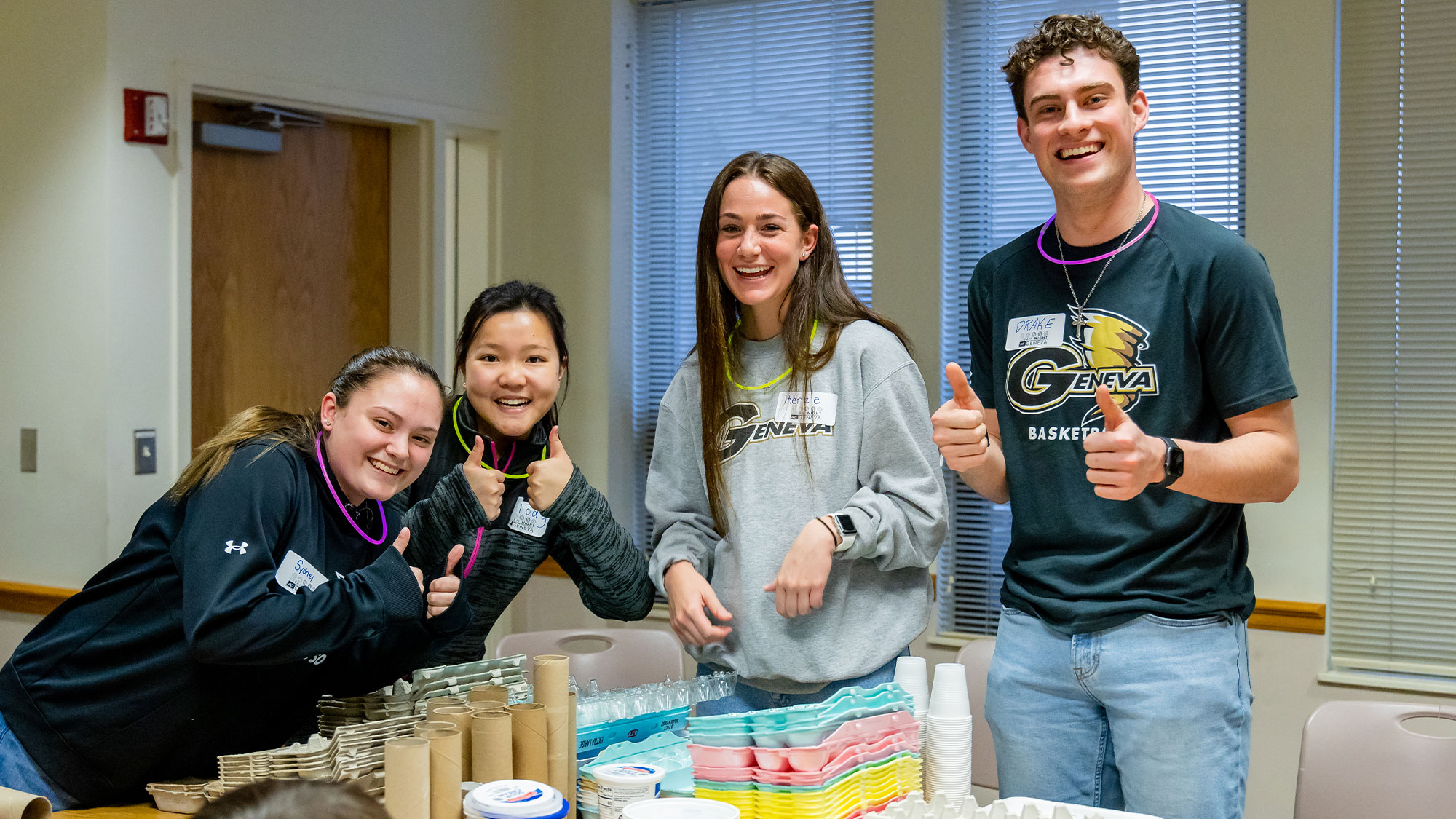
The Honors Program is led by Miller, assisted by Fox. Together, they evaluate incoming freshmen for the program, teach some of the Honors courses, and organize events for its members, among other duties.
Miller and Fox also choose five Honors mentors, who have completed at least the First-Year Fellowship, to support new freshmen in the program. The mentors serve for the full school year, while other Learning and Transition mentors are typically only employed for the fall semester.
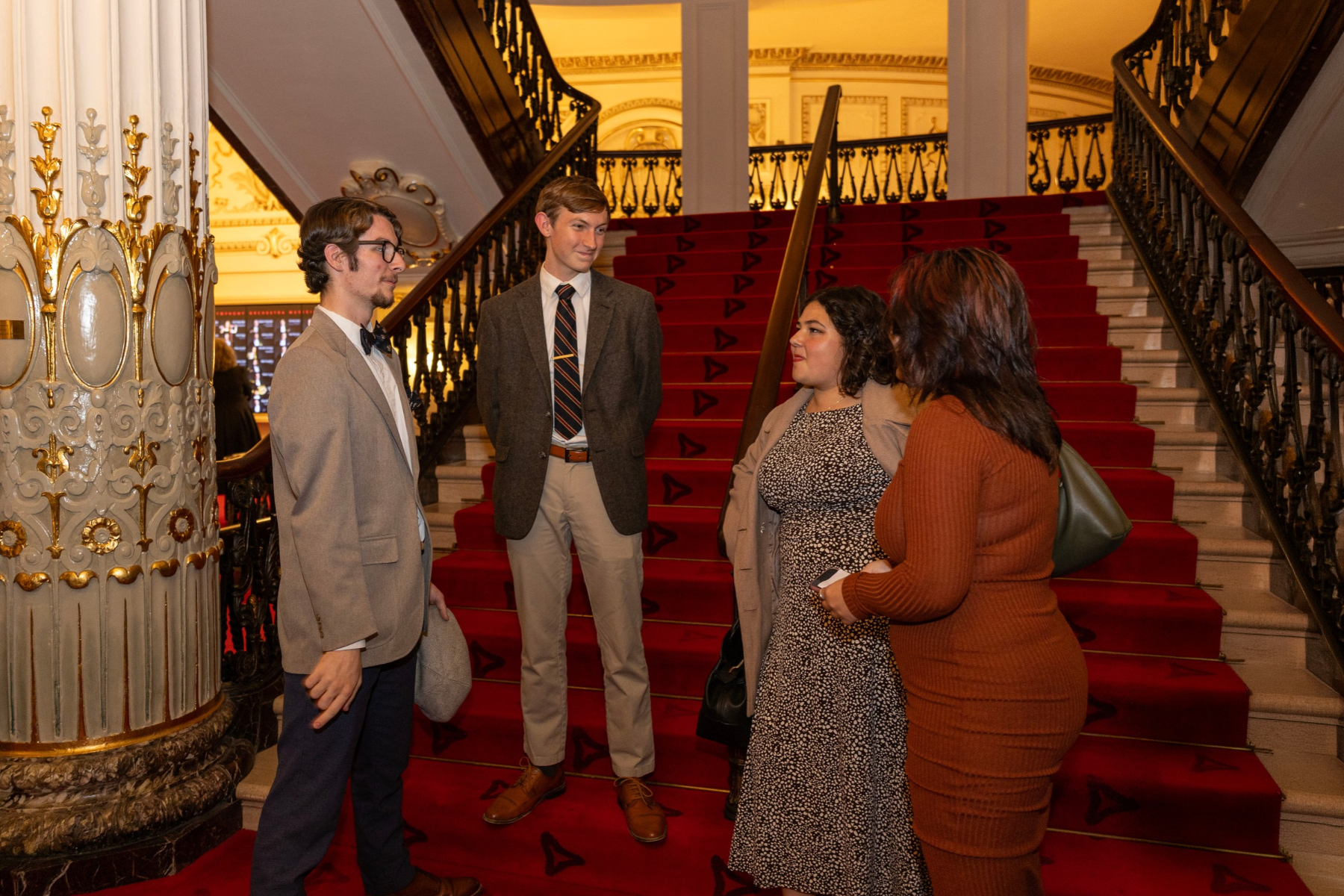
In addition to 15-17 credit hours of study, Honors students attend several cultural events together each year. In previous years they have received free tickets to the Pittsburgh Symphony Orchestra, plays and ballets at the Pittsburgh Benedum Center, and entrance to the Cleveland Museum of Art. Students also enjoy on-campus social events, including weekly Honors lunches in Alexander Hall, the Honors Program Convocation, the Honors Christmas Party, and the Spring Soirée. As Miller notes, the program fosters close friendships that lead to many more spontaneous activities. The Honors community is thriving.
Miller has recognized an encouraging pattern in Honors students. “Students who take part overwhelmingly are devoted to two entwined ideals: to learn at the deepest levels of which they’re capable, and to do so in the company of one another. We see authentic intellectual growth amid the context of genuine friendship. And being part of that is an extraordinary gift,” he says.
Honors students across all four years of the program were recently surveyed for feedback, and their responses show several ways the program has enriched their college experience. Ana Fujisawa ‘28 says she learned to see the Gospel in a new light through taking Honors courses. Zorah Chen ‘29 appreciates being part of a community that “pursues the Truth at its core,” where her eyes have been opened to the joy of the Lord. Carter DiCaprio ‘27 says the program offers him a unique opportunity to study the liberal arts as a STEM major.
When asked about her experience in the Honors Program, Hannah Kyriazis ‘27 says her favorite part has been learning and growing along with her peers through the conversations that have unfolded in Honors classes. Hannah says the program also taught her to take college, and learning in general, more seriously. In the Academic Faithfulness course with President Troup, she gained invaluable knowledge about the Bible, the Lord, and what it means to live as a Christian.
To a high school senior who may be hesitant to compete for a spot in the program, Hannah offers a few words of advice: “Don’t be afraid to put yourself out there! You get to connect with people and professors and learn so much about yourself through being in the Honors Program.”
The Geneva Story publishes content from a variety of contributors across the Geneva College community. The perspectives, experiences, and conclusions expressed in this content are those of the individual authors and do not necessarily reflect the official views of Geneva College, its leadership, or its editorial staff.
Audrey McAlister
- Audrey McAlister '27 is an independent major at Geneva College, studying communication and journalism, and a writing intern in the Office of Marketing and Communication.
- View author



Recent Articles
Engineering Students Connect with Alumni at Michael Baker International
The Honors Program: A Thriving Community of Learners
Beauty and Divine Artistry: Center for Faith & Life Director Publishes Book
Caroline Reed: At the Crossroads of Politics and Business
Men’s Cross Country Captures Second Straight PAC Championship
Five Years of Preparing STEM Teachers Through an NSF Grant
Geneva’s Historic 1926 Victory Over Harvard
Geneva College Announces Honors Invitational 2027 and New Scholarship Awards
Professor Emeritus of Biblical Studies Wins International Psalter Competition
A Closer Look: How Do I Practice Discernment in My College Search?